What changed when a Kia store moved to AI vehicle descriptions?
A Kia store in Southern California moved its listings to generated vehicle descriptions. It reported a sustained rise in organic sessions to its used vehicle detail pages, then its new ones, and 80% less staff time spent on the descriptions. Those are the store's own figures, published with its approval in May 2025, not a forecast for yours.

Ben
- Published
- Updated
- Reading time
- 14 min read
- Sources
- 14 sources

What did the store change?
The store stopped writing vehicle comments by hand and had them built from its inventory feed and factory build data, refreshed every week. Vehicle comments (the listing descriptions shoppers read) had been a chore spread across hundreds of new and used vehicles, and the chore was losing.
The case study we published in May 2025, with the store's approval, describes three problems before the change. Writing a description for every unit took staff time that could have gone to customers. Selling points that live in the build data, the package on this VIN and not on the one beside it, were missed. And the text went stale: once written, a description rarely changed, even when the price did.
The store moved its used inventory first, at the end of November 2024, and its new inventory in February 2025. The product was AI Vehicle Comments, which creates listing descriptions from inventory and factory build data, with the dealership's selling points, certified benefits and custom text, refreshed weekly.
Two things about the rollout matter when you read the results. The used and new inventories were switched three months apart, which gave the store two before-and-after comparisons instead of one. And the store reported the outcome in two measures it already tracked: organic traffic sessions landing on its vehicle detail pages (VDPs), and the hours its staff spent managing comments.
80%
less staff time spent managing vehicle comments, as the store reported
One Kia store's own before-and-after report after moving its used and new listings to generated descriptions. A single client's result, published May 2025 with its approval; not a benchmark.
What happened to the store's VDP traffic?
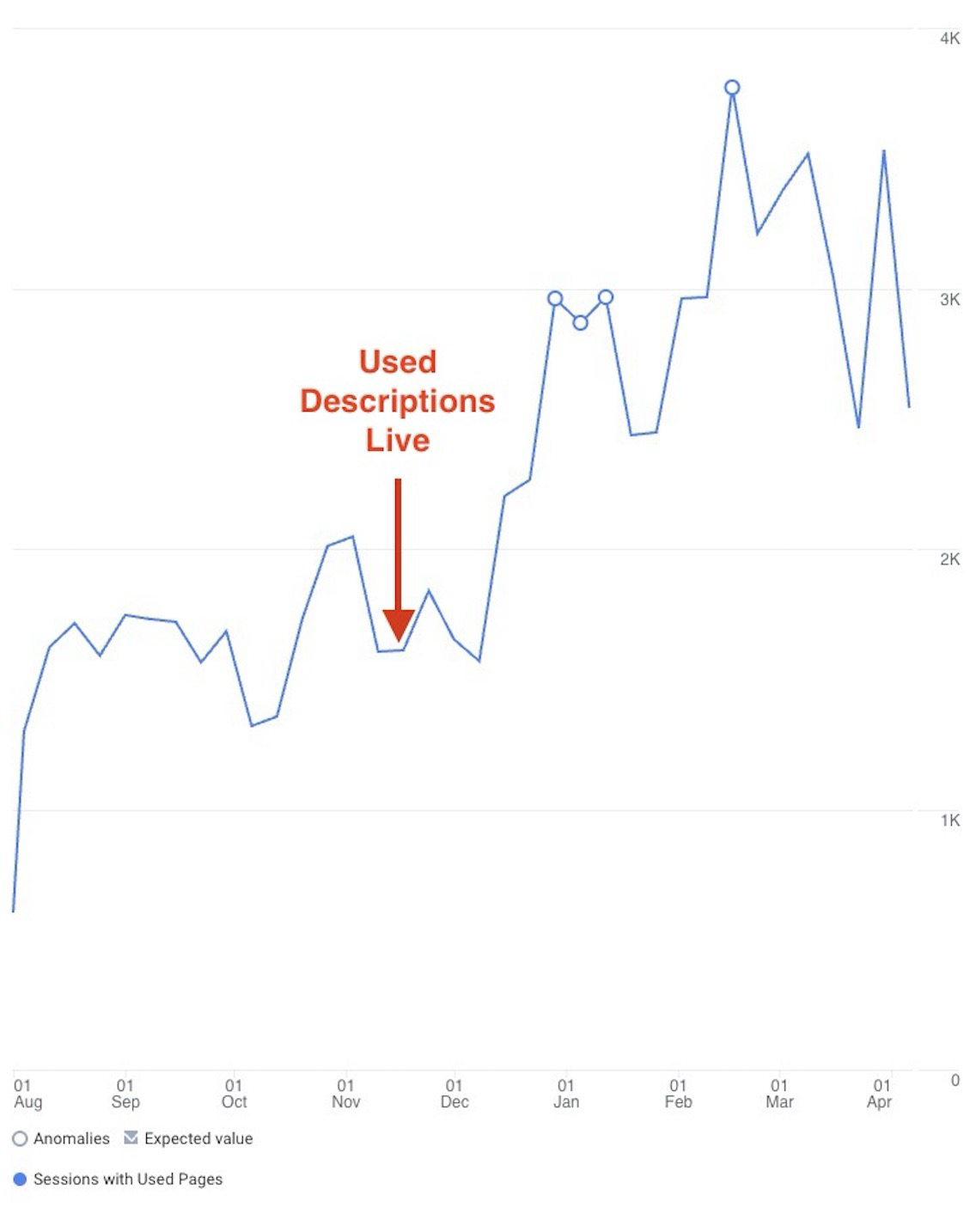
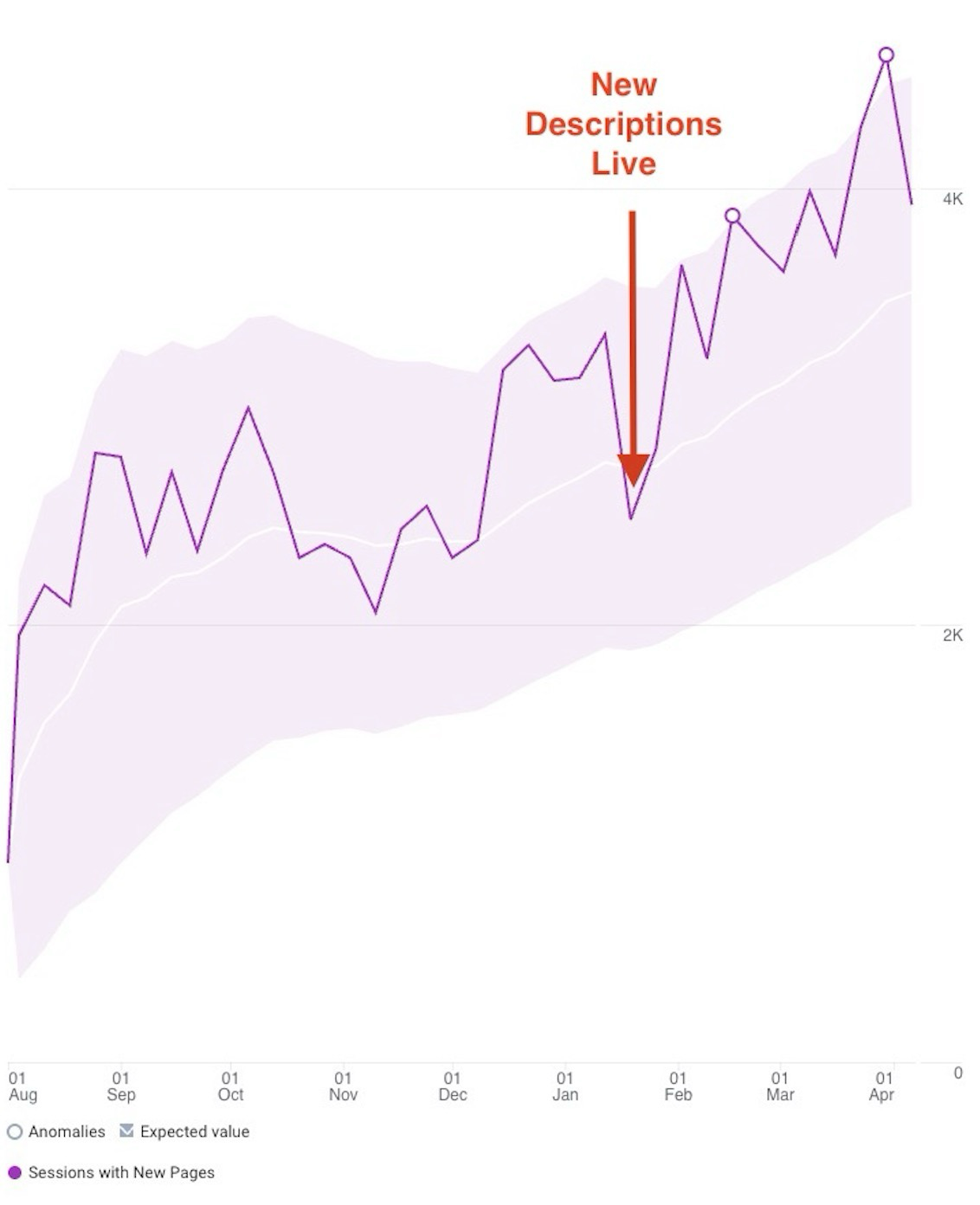
Organic sessions to the store's used-car VDPs showed a distinct and sustained increase after the switch at the end of November 2024. New-car VDPs showed a significant rise after the February 2025 switch. The case study published the used-car sessions as a chart. It reported the direction and persistence of the change rather than a percentage, and this post keeps it that way.
Two more results came from the same period. The store reported an 80% reduction in the time its staff spent managing vehicle comments. On third-party listing sites such as Autotrader, it also saw more VDP views per vehicle, so the fuller descriptions carried beyond its own website.
What those numbers are, and are not. They are one store's measurements over one winter, with the used and new switches three months apart. The case study reports no control comparison, and it does not separate the descriptions from seasonality or from anything else the store changed. They are not sales: sessions and views are shopper attention, and the case study claims no unit count.
The direction fits a published figure that comes close. Cox Automotive reported in 2018, from Autotrader listings, that "New vehicles with comments have shown a 27% increase in VDP views compared to vehicles without comments". It cited its Car Buyer Journey Study of that year and did not publish the sample behind the figure, and the number is eight years old. It is still the closest published number to what the store measured, and a reason to run your own before-and-after rather than borrow anyone's.
| Step | When | What the store reported |
|---|---|---|
| Used vehicles moved to generated descriptions | End of November 2024 | A distinct and sustained increase in organic traffic sessions to used-car VDPs |
| New vehicles moved to generated descriptions | February 2025 | A significant rise in organic traffic sessions to new-car VDPs |
| Staff time on vehicle comments | After both steps | An 80% reduction in the time staff spent managing vehicle comments |
| Third-party listing sites | After both steps | More VDP views per vehicle on sites such as Autotrader |
Source: Dealer Driven Data case study, May 2025, the store's approved results. The store measured its own organic sessions; no percentages were published for the traffic rows.
Key takeaways
- Switch one inventory type first, as this store did with used vehicles, so each switch has its own before-and-after.
- Measure organic sessions landing on VDPs and the hours staff spend on comments before you change anything; those were the two numbers this store could report.
- Build each description from the build data of that VIN, so the package on one unit and not its neighbor is in the text a shopper searches.
- Refresh descriptions on a schedule and confirm with your website provider that the sitemap's lastmod moves when the page text does.
- Read a sample of generated descriptions every week against the actual car; a wrong trim costs more than a stale one.
- Treat one store's result as a reason to measure your own, not as a forecast.
Why would weekly description updates change organic traffic?
Because a page that changes gives Google a reason to read it again, and a description built from build data gives the page the words a shopper types. Google's crawling documentation, updated in July 2026, says its systems "want to recrawl documents frequently enough to pick up any changes". Crawl demand, it adds, varies with a site's update frequency, page quality and relevance. Its sitemap guidance, also updated in July 2026, says the lastmod value "should reflect the date and time of the last significant update to the page". An update to the main content counts; Google ignores the changefreq and priority fields.
That crawling guide is written for sites of ten thousand pages or more, which a dealer website is not. The point for a rooftop (one dealership location) is narrower. A VDP whose text changes, with a sitemap date that moves with it, is a page Google has a reason to re-read; a VDP that never changes is not. Ask your website provider whether the sitemap's lastmod changes when a vehicle's description changes. If it does not, a weekly refresh is invisible to the crawler until it happens to return.
Two limits keep this honest. First, VDPs are short-lived pages. Dale Pollak wrote in Auto Remarketing in 2013 that descriptions "change as vehicles come and go from a dealer's inventory". That makes them, in his words, "too temporal to gain sufficient rank and relevance from search engines". That is still true, and the case study claims no ranking. Its explanation is narrower: descriptions that name the trim, packages and features a shopper searches for, across hundreds of pages that each change weekly.
Second, duplicate text is filtered, not penalized. Google's John Mueller said in 2021 that "you don't get a penalty for duplicate content" and that unique descriptions are "always a good practice". When pages match, he said, Google would "try to pick one of those pages and show only that one". A manufacturer blurb on every unit of the same model is that case.
What a generated description must not do
Three failures turn a time saving into a trust problem.
- Invent a trim or a feature. A prompt kit posted on DealerRefresh in June 2026 lists "Guardrails so it won't invent trim or features the car doesn't have" among its rules. That is the right first rule, and starting from the VIN's build data is the fix.
- Show one price in the text and another on the page. Google's vehicle listings program checks that the price in a dealer's feed matches the price on the VDP. Cars Commerce reported in May 2026 that nearly 40% of shoppers in its Q1 2026 dealership websites study said the listing price did not match the quote they received. The article does not give the sample.
- Add words without adding anything. Google's spam policies, updated in August 2026, call this scaled content abuse. One named example: "Using generative AI tools or other similar tools to generate many pages without adding value for users", however the pages are made.
Does Google treat AI-written vehicle descriptions as spam?
No, not for being AI-written. Google's guidance on AI-generated content, published in February 2023 and still its current page, says that "Appropriate use of AI or automation is not against our guidelines". Its focus, it says, is on the quality of content rather than how the content is produced. The line it draws is purpose: generating content "with the primary purpose of manipulating ranking in search results" is a violation of its spam policies.
For a VDP the test is plain. A description that states what this unit has, from its build data, and changes when the unit changes, adds something a shopper and a crawler can use. The same two paragraphs pasted across every unit of a model add nothing. The August 2026 spam policies name generating many pages "without adding value for users" as the abuse, "no matter how it's created".
Dealers have mostly settled the question by using the tools. A Lotlinx survey of about 215 franchise and independent dealership executives in March 2026, reported by CBT News, found 54% using generative AI tools weekly and 34% monthly. Vehicle descriptions were the most common use, at 24%, ahead of marketing copy at 22%. The same survey shows where generic tools fail. Of those dealers, 84% said they "often" or "almost always" fail to get what they need from generic tools, and only 30% said AI understands their inventory today.
That gap is the difference between a chatbot and a feed. A generic tool knows what a model usually has. It does not know that this unit has the tow package and the one beside it does not, unless someone types that in every time. A description built from the inventory feed and the factory build data starts from the unit, which is what let the store stop writing by hand.
24%
of surveyed dealership executives use generative AI for vehicle descriptions, the most common use named
Lotlinx survey of about 215 franchise and independent US dealership executives, March 2026. 54% use generative AI tools weekly, 34% monthly; marketing copy was next at 22%.
n = 215
How do you measure this at your own store?
-
Fix the URL pattern for your VDPs
Most dealer sites put new and used inventory on distinct paths. Write both down; every step below filters on them.
-
Pull organic sessions by landing page
In Google Analytics 4, report sessions by landing page with the default channel group set to Organic Search. Google defines that group by a medium that exactly matches organic. Filter landing pages to your VDP paths and split new from used.
-
Keep an eight-week baseline
Hold the weekly series for at least eight weeks before you change anything. Note price moves, photo updates and site changes in the same weeks, since those will be your alternative explanations later.
-
Switch one inventory type, then the other
The store moved used vehicles in November and new vehicles the following February. The untouched type is your control for the weeks in between; report it, which the case study did not.
-
Read third-party VDP views per vehicle
Each listing site's dealer dashboard reports VDP views. Divide by the units listed that week so a bigger inventory does not read as a lift.
-
Time the work
Log the hours staff spend writing and fixing comments for a month before and a month after. That is the measure behind the store's 80%.
Questions dealers ask
Will my store see the same result?
Nobody can promise that, and this post does not. The figures above are one store's own measurement over one winter, reported without a control comparison. A generated description changes what a page says and when it changes. What that does to your organic sessions depends on your website, how your provider handles the sitemap and your market. That is why the measurement steps above exist. Run them and you will have your own answer in about three months.
Does Google penalize a manufacturer description used on every VDP?
No. Google's John Mueller said in 2021 that "you don't get a penalty for duplicate content". The cost is filtering: when several pages carry the same text for a generic search, Google tries to show one of them. He also called unique descriptions "always a good practice" while allowing that with a lot of products "it's not always possible". That is the problem build data solves for a dealer with hundreds of units.
How often should vehicle descriptions be refreshed?
On a schedule, and whenever the car changes. The store in this case study refreshed weekly. Keep two clocks apart. The inventory feed is the fast one: Google's vehicle listings program recommends uploading the feed every four hours and expires data after three days. The description text is the slow one, and it should move when the car, its price or its photos do. A weekly rewrite with a daily feed is normal; an hourly feed carrying text from the day the car arrived is the stale case.
Can an AI description invent features the car does not have?
Yes, if it starts from a model name instead of a VIN. One guardrail in the June 2026 DealerRefresh prompt kit is that the tool "won't invent trim or features the car doesn't have", and that line is there for a reason. Start from the build data, keep the option list in the text and read a sample each week against the window sticker. A wrong feature on a VDP is a conversation that starts with an apology.
See what generated descriptions would say about your inventory
AI Vehicle Comments builds listing descriptions from inventory and factory build data, with your selling points, certified benefits and custom text, refreshed weekly. Plans start at $249 a month based on total inventory.
Sources
- Dealer Driven Data case study, 2025, the client's approved results, May 26, 2025
- Dealer Driven Data, AI Vehicle Comments product facts (approved product facts, reviewed October 9, 2026), Oct 9, 2026
- Cox Automotive, Merchandising New Cars: Is It Worth It? (Autotrader listings, citing the 2018 Car Buyer Journey Study), May 2, 2018, May 2, 2018
- Google Search Central, Optimize your crawl budget, last updated July 22, 2026, Jul 22, 2026
- Google Search Central, Build and submit a sitemap, last updated July 8, 2026, Jul 8, 2026
- Auto Remarketing, Dale Pollak, 3 Ways To Make Used-Vehicle Descriptions Shine Online, December 3, 2013, Dec 3, 2013
- Search Engine Journal, Roger Montti, Google on Using Duplicate Manufacturer Product Descriptions (John Mueller, SEO Office Hours), September 24, 2021, Sep 24, 2021
- DealerRefresh forum, Free VDP prompt kit: turn a spec sheet into clean vehicle copy with AI, June 1, 2026, Jun 1, 2026
- Google, How to fix vehicle listings issues (vehicle listings on Google), last updated October 9, 2024, Oct 9, 2024
- Cars Commerce, Jacob Wittler, 5 VDP merchandising mistakes that quietly cost deals and how to fix them (citing the Cars Commerce Dealership Websites Study, Q1 2026), May 6, 2026, May 6, 2026
- Google Search Central, Spam policies for Google web search, Scaled content abuse, last updated August 28, 2026, Aug 28, 2026
- Google Search Central Blog, Google Search's guidance about AI-generated content, February 8, 2023, Feb 8, 2023
- CBT News, The AI gap in automotive retail: dealers embrace AI, but say it falls short where it matters most (Lotlinx survey of about 215 US dealership executives, March 2026), April 7, 2026, Apr 7, 2026
- Google Analytics Help, Default channel group (Organic Search definition)
Ben